Insights, Advice, Brokerage, Corsiva, Interboat, Thames
RIB or Day Boat: Which is right for you?
When the weather is calm and the sun is shining, a great day out on the water is good for the soul. Spending time with family and friends, perhaps with a picnic and some music on board, all with the freedom to explore the beautiful surroundings, is exactly why boating is so popular. When it comes to choosing the right boat to do it in, many prospective buyers spend time considering whether they should opt for a RIB or a day boat. These vessels represent two rather different ideas of a good day afloat, which is exactly why so many buyers find themselves weighing one against the other.
For many years, the highly experienced and knowledgeable team at Val Wyatt has helped countless families through this exact choice. Over the last couple of decades, RIBs have become a familiar sight and, for the right owner, an excellent choice. However, for those who prefer sociable cruising, in comfort, particularly on harbours and estuaries, a day boat can be considered the better option. In this guide, we compare the two honestly, so you can decide which is right for you.
What is a RIB?
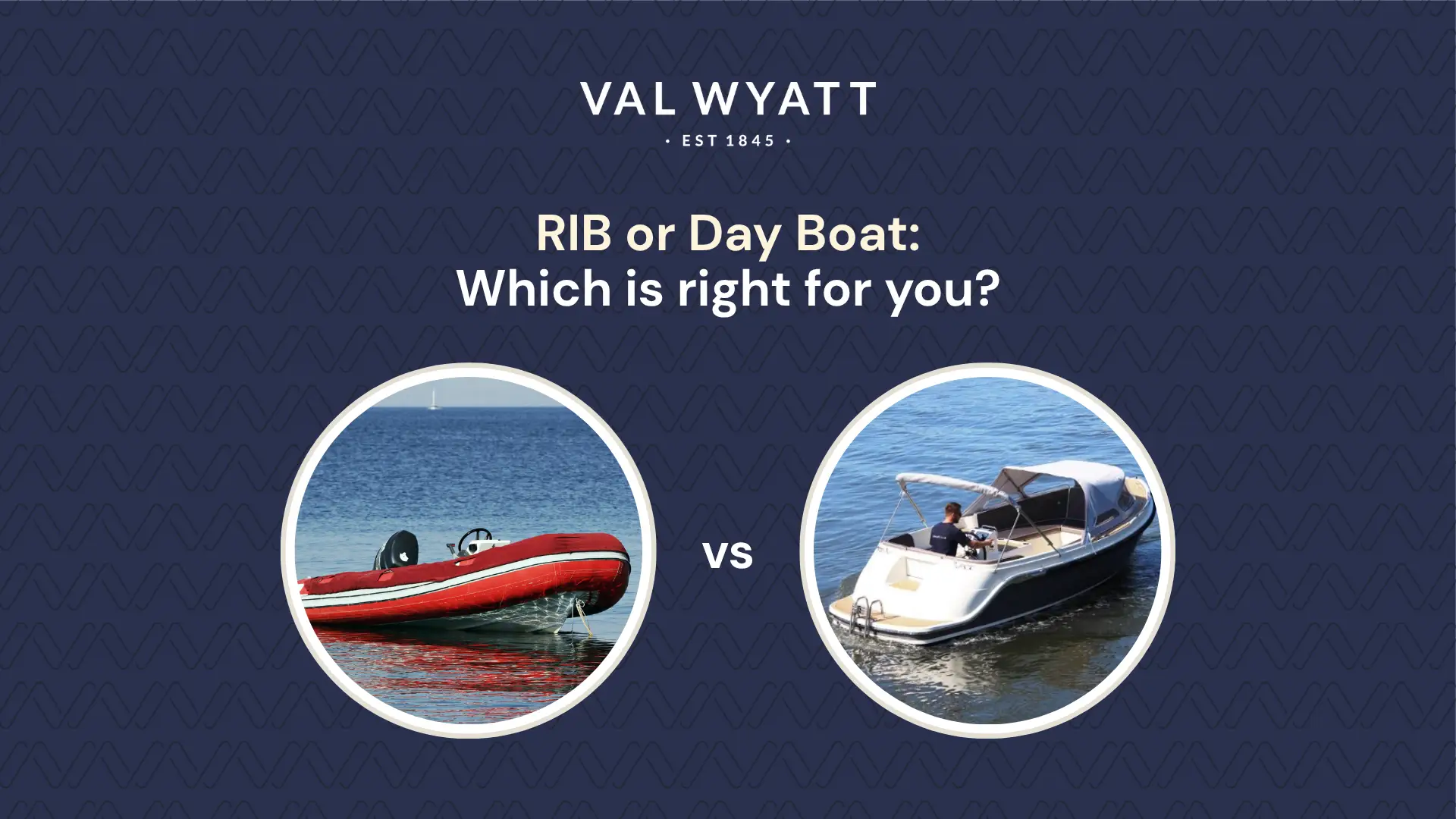
Before comparing the two, we first need to understand exactly what each one is. RIB stands for Rigid Inflatable Boat, and the name describes it rather well. It combines a solid, shaped hull, usually made from fibreglass, with large inflatable tubes running around the outside, known as “sponsons”. This combination is the secret to how a RIB performs out on the water.
The rigid hull is able to cut cleanly through the water and provides a firm base for a powerful engine. At the same time, the inflatable tubes add buoyancy, stability and plenty of shock absorption. As a result, the boat is lightweight, fast, stable, and can handle choppy water well. The word “inflatable” may give people negative connotations of the vessel being flimsy; however, you do feel reassuringly secure on board.
Due to this, RIBs are often used by the RNLI and the military. For leisure boaters, that same capability can lead to an exciting day out. RIBs are well suited to open water and coastal trips, as well as coping admirably when the conditions turn. Over the years, they have become a popular choice for watersports and fishing. They are also relatively easy to tow and launch, which appeals to those who like to load their vessel onto a trailer so they can explore different waters.
What is a day boat?
In this case, the clue is in the name. A day boat, or day cruiser, is designed for comfortable trips out on the water rather than long journeys or overnight stays. Of course, this is a broad term, but it generally describes an open, elegant boat built for ease of use, with plenty of seating for guests and often lots of amenities. Where a RIB is built for capability in rougher weather, it is fair to say that a day boat is built for comfort and ease – however, with the right engine, that need not mean at a slower pace.
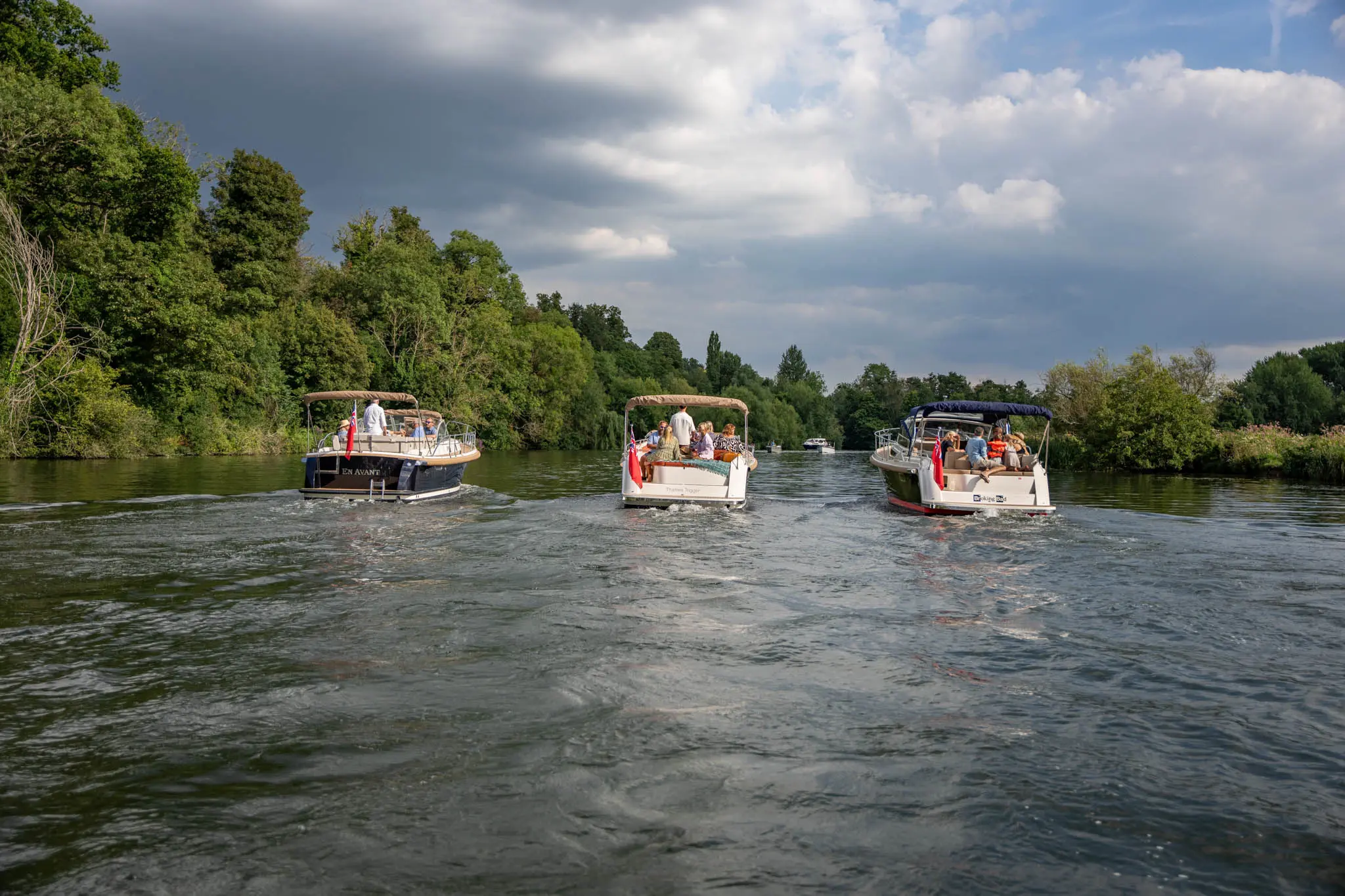
The vessels we know so well at Val Wyatt, from brands such as Interboat (based in the Netherlands) and Corsiva (from Poland), are a perfect example of this. They are characterised by their timeless styling, comfort and spaciousness – with room for ten people or so on board depending on the model.
Many of our day boats for sale also include convenient features such as an integrated fridge, generous storage beneath the seats, and the option of a canopy for shade or shelter, which is often much needed during the warmer summers. (You can read our guide for staying safe on the water during a heatwave here.) Some of the larger models also come with a toilet and cabin for a night onboard, which considerably enhances a day boat’s appeal.
For more information, we recommend you read our ultimate guide to choosing a day boat, which includes more on the manufacturers we partner with, key considerations, safety tips, what you should wear, and more.
RIB or day boat: Key differences
Whilst there is some overlap between the two different boat types, it is fair to say that a RIB and a day boat are designed, for the most part, with different priorities in mind. Here is a closer look at how they compare across the things that tend to matter most.
Comfort and seating
This is where a day boat excels. They almost always feature cushioned seating areas and a sociable cockpit that allows owners to engage more with family and friends – whether that’s for a lunch on board or for a leisurely afternoon or evening watching the world drift by. The Dutch sloop style seen in many day boats offers a helm position at the back of the boat, which ensures that whoever is helming can also see all of their guests and crew, making it a very sociable space. A RIB offers seating too, but it is generally firmer and more functional, designed to keep you secure at speed rather than relaxed.
Weather protection
A RIB is an open and exposed boat by nature. For some people, this can be part of its appeal for a bracing day out, but less so when you would rather stay dry. Many day boats incorporate a sprayhood and a canopy that offer good protection in wet conditions if you’re sitting up front – however the helm will be equally as exposed as on a RIB.
Rough conditions
When it comes to navigating rough conditions, a RIB has the advantage. Its rigid hull and inflatable tubes soak up the waves and handle choppy, open water impressively well. Despite often being Cat B or Cat C, a day boat is happiest in the more sheltered conditions of lakes, estuaries and harbours, and is not designed to be pushed hard through a heavy sea.
Speed and performance
RIBs are lightweight and built to make the most of a powerful engine, so they are quick and highly manoeuvrable. Day boats are mostly used for cruising, but it would be a mistake to assume they are slow. If you specified a day boat with one of the larger engine options (for example, the new Interboat Intender 750 can take up to 110hp), then you have a genuinely quick, responsive boat that will more than keep pace when you want it to and deliver performance you need for waterskiing or wakeboarding.
Storage
A day boat tends to offer more practical storage, with generous space beneath the seats for picnics, equipment and anything else a family requires for a day on the water. Storage on a RIB is usually much more limited, reflecting its more minimal design.
Facilities
Larger day boats can be fitted with genuinely useful features, including a table, sink, fridge, swimming platform, and even a toilet. You can also find a small cabin on some bigger models. RIBs under 30ft rarely offer facilities of this kind, keeping things simple and open instead.
Price
Both day boats and RIBs are available at a wide range of prices, so much depends on size and specification. It is worth knowing, though, that a RIB fitted with a large, high-performance engine can become surprisingly expensive. A comparable day boat often delivers more comfort for the money, if speed isn’t a priority.
Best-suited waters
A RIB is often in its element in open waters and around the coast, whilst a day boat is perfectly suited to the harbours, estuaries, lakes and rivers, where so many of us actually spend our time. However, a day boat is perfectly adequate for shorter coastal trips in calmer weather.
Jack Holliday, our Boat Sales Broker, based at our office in Chichester Marina says, “Some people around the south coast tend to dismiss day boats too quickly because they think they can’t pop over to the Isle of Wight in them. However, if you put a bigger engine in one of our eight-metre launches, you’d comfortably get across in most conditions. Realistically, even in a RIB you’d wait for a calm day if you had friends aboard – so you’d pick a nice, settled day either way, and you’d be far more comfortable doing it in a day boat.”
Can you do watersports behind a day boat?
This is a question we are asked more often than you might think, usually by families who love the idea of a chilled day on the river, but do not want to give up the fun of towing a wakeboard or water skier.
We will be perfectly honest. If watersports are the main reason you are buying a boat, and you want to do it week in, week out, whatever the conditions, a dedicated speedboat or a RIB will do the job better and more consistently than a day boat.
That said, a day boat with the right engine is more capable than many people realise. On a calm day, with a suitably powered outboard or inboard, a day boat such as an Interboat can comfortably get a wakeboarder or skier up and out of the water. It will not replace a purpose-built ski boat, but as an occasional pleasure on a still summer morning, it is very much do-able.
Finally, when the towrope is put away, you still have all the advantages of a day boat at your disposal. Where a RIB or speedboat leaves you with limited storage and little shelter, a day boat provides all the added comforts for you to enjoy the rest of the day. For many families, that combination of occasional watersports and everyday comfort is the best of both worlds.
The RYA Powerboat Level 2
Whether you opt for a day boat or a RIB, a little training can go a long way, especially if you are new to boating.
One of the most popular options is the RYA Powerboat Level 2. This is a two-day practical course covering the essential skills of handling a powerboat safely and confidently. It is regularly delivered by a number of RYA-recognised training centres, including commercial sea schools, inland watersports centres and sailing and yacht clubs.
Whilst the courses are very often taught on RIBs, they are also highly valuable for day boat owners. You will learn key skills such as close quarters handling, man overboard recovery, an introduction to driving at planing speed and collision regulations. You can find the full details on the RYA website.
On completion, you can then also apply for an International Certificate of Competence (ICC), which covers powerboats up to ten metres. This is well worth having if you ever plan to take or rent a boat abroad.
Do you need a licence?
This depends. If you intend to cruise the Thames or other inland waterways, you will typically need a valid Boat Safety Scheme certificate and a waterway licence, whichever type of boat you choose. We have covered all of this in detail in our guide to boat licences in the UK, which is well worth a read before you take the plunge. In terms of coastal areas and harbours, a licence is not required. However, you will be responsible for a vehicle that can travel at speed, and, therefore, you will need to be competent
Making the decision: RIB or day boat?
When it comes to buying a boat, it is important to choose one that fits the way you want to spend your time on the water.
Jack says: “RIBs are incredibly popular down in Chichester, but a lot of them are only used occasionally – for example, when friends come down from London and they head to the beach. If you’re taking a big group out for the day, you’re not really using a RIB to its full potential. You’d be far better off in a comfortable boat with a fridge, a toilet and all the things you get with an Interboat. When you invest money into a boat, you want it designed for the way you’ll use it most of the time, not necessarily for five minutes blasting around the Solent.
“That’s not to say that RIBs aren’t excellent boats. There are times when they’re exactly the right choice – supporting kids sailing in the harbour or getting somewhere quickly when the weather turns. But be honest with yourself about how many days a year you’d actually want to head out in the wind and rain. For the way most of us actually use a boat, I can’t think of much a RIB would do that a day boat wouldn’t – and you’d be doing it in far more comfort.”
Day boats: A fantastic alternative
RIBs are hugely popular, and for good reason, but they are not the only option. For many buyers, a day boat makes an excellent alternative that is well worth considering before you make that all important final decision.
If you’re all about the open water and coastal adventures, a RIB may well be for you. However, if you are looking for something a little more relaxed and sociable then a day boat is a sensible choice. It offers comfort, storage and shelter a RIB cannot match, and as we previously discussed, the right day boat can even turn its hand to the occasional bit of watersports when the mood takes you.
Whichever way you are leaning, it always helps to talk it through with people who know these different boats – and their pros and cons – inside out. Our team is happy to share honest advice and to let you see the options for yourself, including the Interboat and Corsiva ranges, at our marina in Wargrave and our South Coast sales office in Chichester. You are also welcome to browse our current boats for sale online whenever it suits you.
This includes the award-winning Interboat Intender 750, the latest addition to the Interboat family. Its engine sits beneath the deck, which opens up the cockpit. Instead of a central engine box, you’ll find a clean, open space with just a slim steering console, which allows for more room for entertaining. In addition, the Corsiva 800 Tender is a stylish and comfortable boat, which includes a bow thruster, fridge, pump-flush toilet and can be fit with up to a 175hp outboard engine.
Browse our new boats for sale in the UK (both new in stock and new to order), as well as a number of used boats for sale here. You can also find our day boats for sale here. Alternatively, contact us on 0118 940 3211 (Wargrave) or 01243 217485 (Chichester) or fill in our online form and we will get back to you as soon as possible.